Over more than a decade, I have worked across marketing, growth, operations, product, partnerships, AI, Web3, crypto and iGaming. These areas connected naturally in practice, but on LinkedIn and in older CVs, the breadth could easily look unfocused.
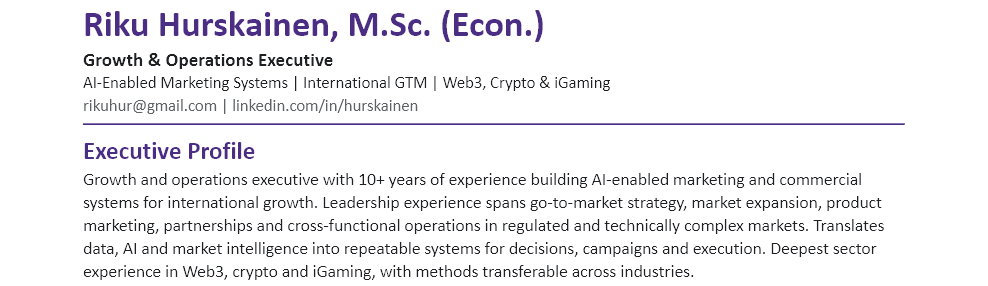
The project began with a simple goal: make my experience easier for recruiters and business leaders to understand. It started with LinkedIn and a new executive CV, then expanded into a maintained career evidence base that could support future applications, portfolios, interviews and professional content.
Finding the thread
The central positioning became clear: I am a growth and operations leader who builds AI-enabled marketing and commercial systems.
Web3, crypto and iGaming demonstrate experience in international, technical and regulated markets that move quickly. They provide the setting for the work without limiting where the underlying skills can be applied.
This positioning connected market research, go-to-market strategy, product ownership, acquisition, partnerships, community building and AI systems into one professional story. It also supports senior growth, CMO, COO, CGO and general-management opportunities.
Rebuilding the evidence with AI
My career information was spread across LinkedIn, several CV versions, portfolios, project files and direct corrections. Some descriptions were outdated, while others used figures that referred to different scopes or measured the less meaningful part of a result.
AI helped compare the material, find inconsistencies and organise the evidence.
One AI market-intelligence project, for example, had grown to cover 200 markets across 25 variables and more than 14,500 source inputs. Older material still carried an earlier figure. Budget descriptions also needed clearer context, while one acquisition campaign was better explained through thousands of new registrations than through the volume of messages sent.
AI browsing was also used to open my live LinkedIn profile through my signed-in browser and capture the visible information directly. The profile was pulled into a factual baseline without manually copying and pasting every section. This made it possible to compare the live profile with the approved material and identify outdated or inconsistent wording.
I made the final decisions about which facts were current, how they should be explained and what could be used publicly. Sensitive achievements remained available internally with clear publication rules.
Turning the evidence into useful materials
The LinkedIn profile was rebuilt section by section around the new positioning. The executive CV was reduced to two pages with a clear structure, simple design and focus on senior responsibility, business scale and confirmed results.
I also created a confidential portfolio for a specific senior Head of Growth opportunity. It selected four relevant cases and gave each enough space to explain the situation, my role, the work completed and the outcome.
Behind these materials, I built one maintained career library containing my role history, results, current figures, confidentiality decisions, interview stories and case studies.
LinkedIn presents the wider professional story. The CV gives recruiters a fast executive overview. The portfolio provides more depth through selected cases. The career library keeps the underlying evidence consistent across all three.
The library is also structured for AI use. When a new application, interview, biography or article comes up, an AI assistant can select the evidence most relevant to that purpose. I then decide what is published and how the final story is presented.
What could this become?
The materials are now ready for regular use. The next questions will be answered through real opportunities and feedback.
Will a clearer story lead to more relevant recruiter conversations? How much time will the library save when I tailor an application? Which examples will hiring managers remember, and which ones will still need more context?
Profile activity, recruiter responses, interviews and preparation time can gradually show where the system creates value and where it needs further work.
I also keep a broader question in mind. Most experienced professionals have valuable evidence scattered across old CVs, profiles, presentations, project files and memory. How much of that value stays invisible because it cannot be found when the right opportunity appears?
As AI browsing and reasoning continue to improve, a maintained career library could support applications, interviews, professional content, advisory work and career decisions from the same evidence. I intend to keep using, measuring and updating the system to see how far that idea can develop.