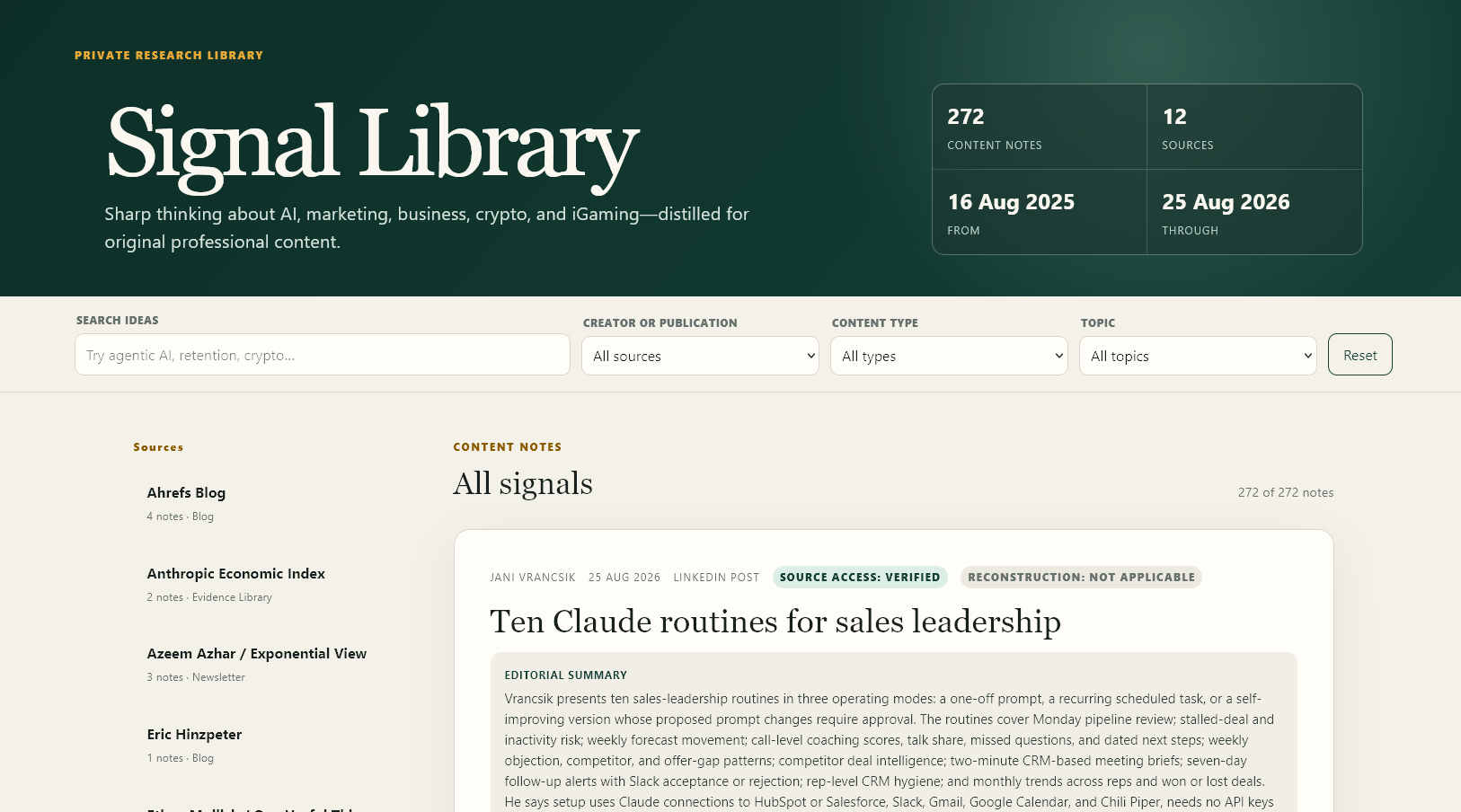
Useful material about AI and business was spread across LinkedIn, newsletters, blogs and research reports. I had saved plenty of it, but finding the right source again when I wanted to write was slow. Older LinkedIn posts were especially difficult to recover, and saved links often lacked the context that made them useful.
I decided to build one local content library around the subjects I work with: AI, marketing, growth, sales and business operations, with selected material from crypto and iGaming.
Finding the useful material
The first job was to collect material from people and publications I considered valuable. LinkedIn proved to be the hardest source because its activity feed is a poor archive.
One priority profile had an interim collection of 18 relevant posts. A wider review of the profile and its direct post pages found 129.
That alone showed why a proper library was needed. Useful work was hiding behind an interface that was never designed for research.
I reviewed priority profiles, newsletters, specialist websites and research sources. As of 25 August 2026, the library contained 272 selected posts, articles and reports from 12 sources. Most of the collection came from two priority profiles that were reviewed in depth. This provided a clear view of how each person approached different AI and business topics over time.
Keeping the library useful
Every item had to earn its place. It needed a useful idea, clear business relevance and a source that could be found again.
The library keeps the main point, practical implication, original link and publication date together. Incomplete material was marked clearly or left out.
Creator opinions and primary research were also separated. This makes it easier to use a strong opinion as the starting point for an article while checking important claims against available research.
The collection opens locally in a simple browser view. I can browse the newest material, search for a subject and filter the results by source or topic. I can also refresh the collection with a simple command when I want new material added.
Connecting it to an AI writing assistant
The library was also made compatible with MCP, a standard way for AI tools to access external information. I used this connection to plug the library into a separate AI writing assistant.
The assistant can search the collection locally, find related topics and bring a focused group of sources into a writing project. It can compare different views on the same question and add relevant research when a claim needs support. For each article, it pulls the material connected to that specific subject.
This is especially useful when I know the broad area but have not yet found the final angle. I can start with a subject such as AI adoption in small businesses or the effect of AI agents on marketing operations. The assistant then shows what the library already contains and helps me identify the most useful direction.
The original source links remain connected to the material, making final checks easier. The assistant helps with research, topic selection and early drafts. I still choose the argument, decide which claims are strong enough to use and edit the final article into my own voice.
The result
The project created one working research base for AI, marketing, growth and related business topics. It gives me a clear way to move from a broad idea to useful sources and a focused article direction.
The library has already worked extremely well for writing LinkedIn posts and short articles. I expect it to become my go-to source of inspiration for AI, marketing, growth and many other topics as I continue to use and update it.